羅氏眼科臨床研究賦能工作坊教材
讓你的 Faricimab RWE 長得像 Ophthalmology 論文
前言
Document Number: M-TW-00008758
Disclaimer / 免責聲明
The Information is designed and provided to HCP with scientific, non-promotional information solely for the scientific and educational purposes, without any intent to promote or exchange for recommending, prescribing, dispensing, purchasing, supplying, selling, administering, referring, arranging for, or ordering any pharmaceutical products in the future.
The information may contain off-label or pre-approval information of certain pharmaceutical products whose efficacy and safety are still under investigation. Regulatory approval is dependent on the completion of investigation and review by local regulatory authorities. Such off-label or pre-approval information is presented only for purposes of providing an overview of clinical data. It should not replace your independent professional judgment, and should not be construed as a recommendation for use of any product for unapproved uses. Roche does not endorse or approve, and assumes no responsibility for the content, accuracy or completeness of this Information presented.
歡迎來到「羅氏眼科臨床研究賦能工作坊」——副標:「讓你的 Faricimab RWE 長得像 Ophthalmology 論文」。
這份教材的目標不是讓你學會 R,也不是讓你學會 MMRM 或 CMH 的數學原理。 是讓你下課後做得到這件事:
拿你院內的 faricimab cohort,產出可以投 Ophthalmology 的圖表。
📣 主辦單位與利益揭露
- 主辦單位:羅氏大藥廠(Roche Products Ltd. Taiwan)
- 作者:和信治癌中心醫院 林協霆醫師、羅氏大藥廠 邵時傑博士
- 資金:本工作坊由羅氏大藥廠贊助舉辦。教材內容以方法學教學為主,所有藥物以學名(faricimab、aflibercept)呈現,不使用商品名;圖表配色為教材中性色,與任何商品識別色無關。
- 教材授權:CC BY 4.0,可自由修改、再散布、引用。
- AI 工具:本書建議搭配 free-tier ChatGPT / Gemini / Claude 使用;AI 生成的內容仍可能有錯誤,請對照教材中提供的參考程式碼與引用文獻,自行驗證。
🔗 重要連結(書籤起來)
📌 跑這本書 / 跑這課
| 用途 | 連結 |
|---|---|
| 📖 線上書(這本,可分享) | https://htlin222.github.io/roche-vabysmo-rwe-workshop/ |
| 📦 程式碼 repo(給 Posit.Cloud fork) | https://github.com/htlin222/roche-vabysmo-rwe-workshop |
| 🧪 Posit.Cloud(瀏覽器跑 RStudio) | https://posit.cloud/ |
| 🎁 老師預烤 Posit.Cloud project(🥇 建議路線,套件已裝好) | https://posit.cloud/content/12416569 |
🤖 AI 助手(free-tier 都可以)
| 工具 | 連結 |
|---|---|
| ChatGPT | https://chat.openai.com/ |
| Google Gemini | https://gemini.google.com/ |
| Claude | https://claude.ai/ |
3 選 1 即可,本書的 📋 prompt 在哪一個都跑得出 R code。
📑 參考材料 / 速查
| 用途 | 連結 |
|---|---|
| 原始論文(CC BY 全文) | Cheung 2025 Ophthalmology — DOI |
| 院內 csv schema | data/data_dictionary.md |
| 模擬資料下載 | data/ 全部 csv |
| 課堂 FAQ(29 Q&A) | docs/faq.md |
| 名詞 / 縮寫速查 | Appendix G |
| 統計 / 程式 ELI5 | Appendix E、F |
課程目標
今天結束時,你應該可以:
- ✅ 看懂一篇眼科 RWE paper 的圖表是用什麼方法跑出來的
- ✅ 把問題講清楚,讓 AI 幫你寫 R 程式碼
- ✅ 在 Posit.Cloud 上跑出 Table 1 + Figure 1(MMRM)+ Figure 2(CMH)
- ✅ 把同一份 code 套到「你院內的 csv」,看圖換掉
- ✅ 知道你回院後要請 IT 撈什麼樣的資料
這堂課的玩法
| 步驟 | 你做的事 |
|---|---|
| 1 | 複製本書的「📋 prompt」 |
| 2 | 貼給 AI(ChatGPT / Gemini / Claude,free-tier 即可) |
| 3 | AI 給你 R code |
| 4 | 貼到 Posit.Cloud 跑 |
| 5 | 看結果、聽我們解釋 |
你的工作是「問對問題」、「看懂結果」,不是「寫對程式」。
⚠️ AI 給的 code 跟教材不同?以教材為準
為了讓全班跑出一致的結果,每個任務後面都附「參考程式碼」一欄。 - 學員與 AI 對話只是在練「拆需求 / 看懂程式」,AI 的版本可能用不同套件、不同命名、不同預設參數。 - 真正下指令跑的時候,請統一複製教材的「參考程式碼」——這樣老師、助教、同學的圖才會對得上。 - AI 對於「眼科專業內容」與「統計細節」仍有可能出錯:碰到 reviewer 才會在意的細節(例如 random effect 結構、CMH 權重公式、PSM caliper 設定),請以教材中標註 ref 的內容為準,並自行驗證。
🚀 完全不想看 code?6 支腳本一行跑完
打開 Terminal,確認 CWD 在專案根目錄,依序:
Rscript START.R                               # 第一次裝套件(一鍵入口,內部呼叫 setup/install.r)
Rscript scripts/01_table1.R             # Part 2
Rscript scripts/02_mmrm_figure1.R       # Part 3
Rscript scripts/03_cmh_figure2.R        # Part 4
Rscript scripts/04_km_figure3.R         # Part 6
Rscript scripts/05_psm_my_hospital.R    # Part 5(PSM + matched MMRM/CMH)
完整對應表與前提條件見附錄頂端「🚀 完全不會寫程式:6 支腳本一行跑完」。
🔖 看到陌生縮寫不要慌
本書最後的 Appendix G「名詞速查表」 整理了眼科、試驗、統計、工具的所有縮寫。 看到 BCVA / CST / MMRM / CMH / PSM / ASMD / Q4W 等不認得 → 翻 appendix G.1–G.5。 看到方法概念不懂(什麼是 random intercept、censoring、propensity score)→ 翻 appendix E、F 的 ELI5。
TENAYA / LUCERNE:我們今天要 reproduce 的 paper
Cheung CMG, Lim JI, Priglinger S, et al. Anatomic Outcomes with Faricimab vs Aflibercept in Head-to-Head Dosing Phase of the TENAYA/LUCERNE Trials in Neovascular Age-related Macular Degeneration. Ophthalmology. 2025;132(5):519-526.1
一頁懶人包:
| 項目 | 內容 |
|---|---|
| 設計 | TENAYA + LUCERNE 兩個 phase 3 RCT 的 pooled post-hoc analysis |
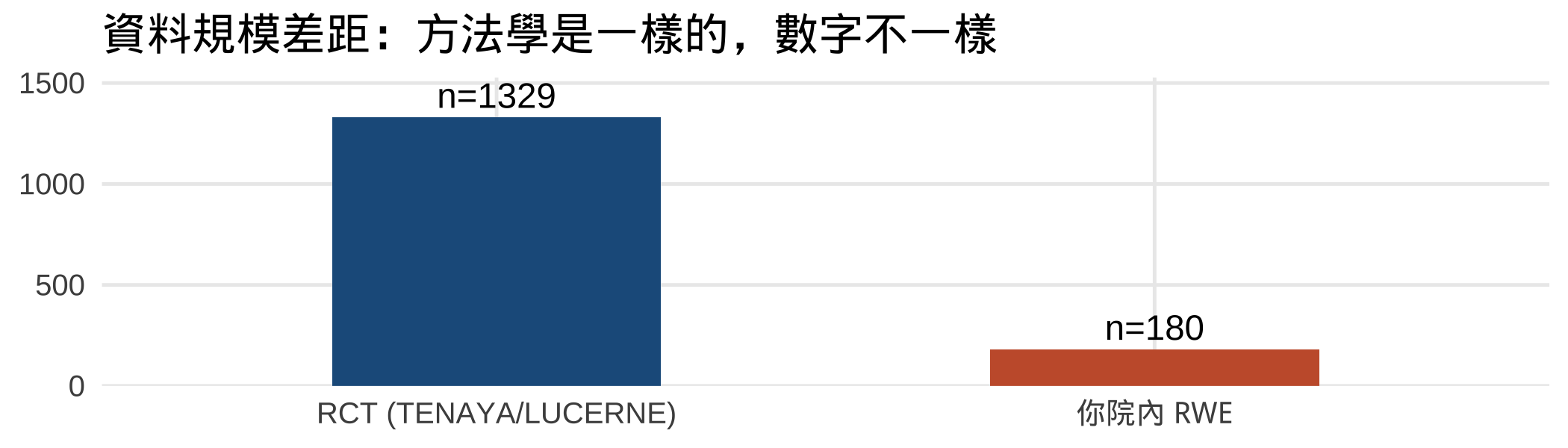
| N | 1329 病人(faricimab 665 vs aflibercept 664) |
| 時間窗 | 前 12 週 head-to-head dosing phase(兩臂都打同 3 針 Q4W) |
| outcomes | BCVA、CST、IRF/SRF absence proportion、time to first absence |
| statistical methods | MMRM(連續變項)+ CMH-weighted(二元變項)+ Kaplan–Meier(time-to-event) |
| 結論 | faricimab 在 anatomic outcomes(CST、SRF absence)優於 aflibercept,BCVA 接近 |
📖 outcomes 名詞速解
- BCVA = best-corrected visual acuity,最佳矯正視力,用 ETDRS letters 計分(0–100,越高越好)
- CST = central subfield thickness,OCT 量到的中央視網膜厚度(單位 μm)
- IRF / SRF = intraretinal / subretinal fluid,視網膜內 / 下液(OCT 看得到的積水)
- absence proportion = 看不到 fluid 的病人比例(治療目標:把這個比例做高)
- head-to-head = 兩藥同期同 dose 直接對打(前 12 週兩臂都是 Q4W 三針)
📖 method 名詞速解
- MMRM = mixed model for repeated measures,「同一隻眼睛被量很多次」的迴歸
- CMH-weighted = Cochran-Mantel-Haenszel 加權;先在每個分層算差異、再加權平均
- Kaplan–Meier = 「時間到事件」的階梯狀曲線(如多久才把 fluid 擠光)
完整 ELI5 在 Appendix E。
📄 完整 PDF 在
refs/tenaya-lucerne-paper.pdf(CC BY 授權,可下載)。
工作坊全圖
| 章節 | 主題 | 預計時間 | 你會做出 |
|---|---|---|---|
| Part 1 | 認識 paper + 認識資料 | 30–40 min | Posit.Cloud 開好、看到模擬資料的欄位 |
| Part 2 | Table 1 baseline characteristics | 20 min | 一張對得起 paper 的 Table 1 |
| Part 3 | Figure 1:MMRM 跑 BCVA + CST | 40 min | 兩張隨時間變化的曲線圖 |
| Part 4 | Figure 2:CMH 跑 IRF/SRF/both | 30 min | 三張 absence proportion bar chart |
| Part 5 | 換你院內資料 | 30 min | 同一份 code、跑出「假裝是你院內」的 paper draft |
| Part 6 | (bonus) Figure 3:KM + Cox | 20 min | 一張 time-to-event 曲線 |
| 附錄 1 | 你回院之後要做的事 | — | 院內 csv schema、AI 對話技巧、常見錯誤 |
| 附錄 2 | 給非眼科醫師的背景補充(Primer) | 30 min | nAMD / anti-VEGF / OCT 的暖身(眼科醫師可跳過) |
| 附錄 3 | R 語言入門(基本概念) | 30 min | 看懂本書每段 code、會改參數(沒寫過 code 也 OK) |
| 附錄 4 | Prompting 心法:讓 AI 幫你寫 code | 20 min | 會寫出好 prompt、懂得驗證、不外洩病人資料 |
一個重要的觀念
RCT 是「用 1329 個病人證明藥的效果」;RWE 是「用你院內 100–200 個病人展示同一個方法在你的人群跑出什麼樣」。 方法不變,能講的故事略小——這就是為什麼你今天學的 code 可以直接搬。
老師快速指引
- 沒看過 R 也沒關係,跟著「📋 複製這段話貼給 AI」就好
- 卡住舉手,助教會來看
- 結束時你會帶走:一個 Posit.Cloud project + 這本書的 PDF + 院內 csv schema
1.
Cheung CMG, Lim JI, Priglinger S, et al. Anatomic outcomes with faricimab vs aflibercept in head-to-head dosing phase of the TENAYA/LUCERNE trials in neovascular age-related macular degeneration. Ophthalmology. 2025;132(5):519-526. doi:10.1016/j.ophtha.2024.11.023