Does TLS at presentation predict worse outcome in lymphoma?

A rapid evidence synthesis · 6 cohorts · 857 patients

Hsiehting Lin

April 11, 2026

Today’s question

My Burkitt patient just developed laboratory tumor lysis syndrome on day 2 of chemotherapy.

Should I be worried?

  • Rapid evidence synthesis
  • 6 comparative cohorts · 857 lymphoma patients · 223 with TLS
  • Pooled estimate · GRADE · clinical bedside summary
  • 5 minutes · 10 slides · all artifacts on GitHub

Why this question — Background

  • TLS is an oncologic emergency — well known, well managed (Cairo–Bishop 2004; Howard 2011; Bociek & Lunning NEJM 2025)
  • Incidence is well described in every textbook; prognostic effect has never been pooled
  • Strong administrative-data signal: NHL + TLS in-hospital mortality 28.3 % vs 5.1 % without TLS (NIS 2019–2020, adjusted OR 7.3
  • Existing reviews focus on drug-specific TLS (venetoclax, TKIs), management algorithms, single-disease cohorts — not on TLS as a prognostic marker in lymphoma

Gap: No published meta-analysis of comparative cohort studies answers “Does TLS at presentation independently mark a higher-mortality lymphoma patient?”

¹ NIS 2019–2020 analysis, J Clin Oncol 2024 suppl 16, abstr e19032

What we did — Methods

  • Search: PubMed + Scopus, inception → 10 April 2026
  • Pipeline: 766 records → 669 deduped → 33 PubMed-screened → 6 included
    • Plus post-hoc Scopus enrichment (CrossRef + OpenAlex) → 1 more (Sall 2026)
  • Eligibility: comparative cohort, lymphoma, TLS-stratified mortality
  • Synthesis: random-effects pool, DerSimonian–Laird, HKSJ correction (k < 10)
  • Risk of bias: QUIPS (single rater)

Warning

Honest framing: This is a rapid evidence synthesis, not a full systematic review. Single-AI screening, no PROSPERO, two databases. Use as hypothesis-generating, not as a guideline source.

From search to synthesis — 766 → 6

Five filtering steps

  1. Merge two databases
  2. DOI + fuzzy title dedupe
  3. Title pre-filter ⚠️
  4. AI abstract screen
  5. Full-text eligibility

Step 3 is the non-standard one — 611 records excluded on title alone. Recall gap, documented in limitations.

Six studies, four decades, four continents

Study Country Population n TLS+ Effect (95 % CI)
Mansoor 2019 Pakistan Pediatric B-NHL (Burkitt 69 %) 233 48 aOR 7.84 (3.16–19.4)
Canet 2013 France ICU (multi) Adult heme (lymphoma 42 %) 153 47 aOR 2.45 (1.09–5.50)
Zeng 2024 China Pediatric HG B-NHL R3/R4 283 76 OR 2.43 (1.17–5.08)
Bozkurt 2024 Turkey Pediatric NHL (Burkitt 75 %) 107 33 OR 1.56 (0.41–5.93)
Lin 2020 Taiwan HIV-NHL adult 22 5 OR 11.30 (1.10–115)
Alavi 2006 (sensitivity) Iran Pediatric NHL 59 14 OR 24.4 (1.18–506)

Point estimates span OR 1.6 to 24 — a clue that “TLS at presentation” is not one biological entity.

Headline result — Pool F minus Alavi (k = 5)
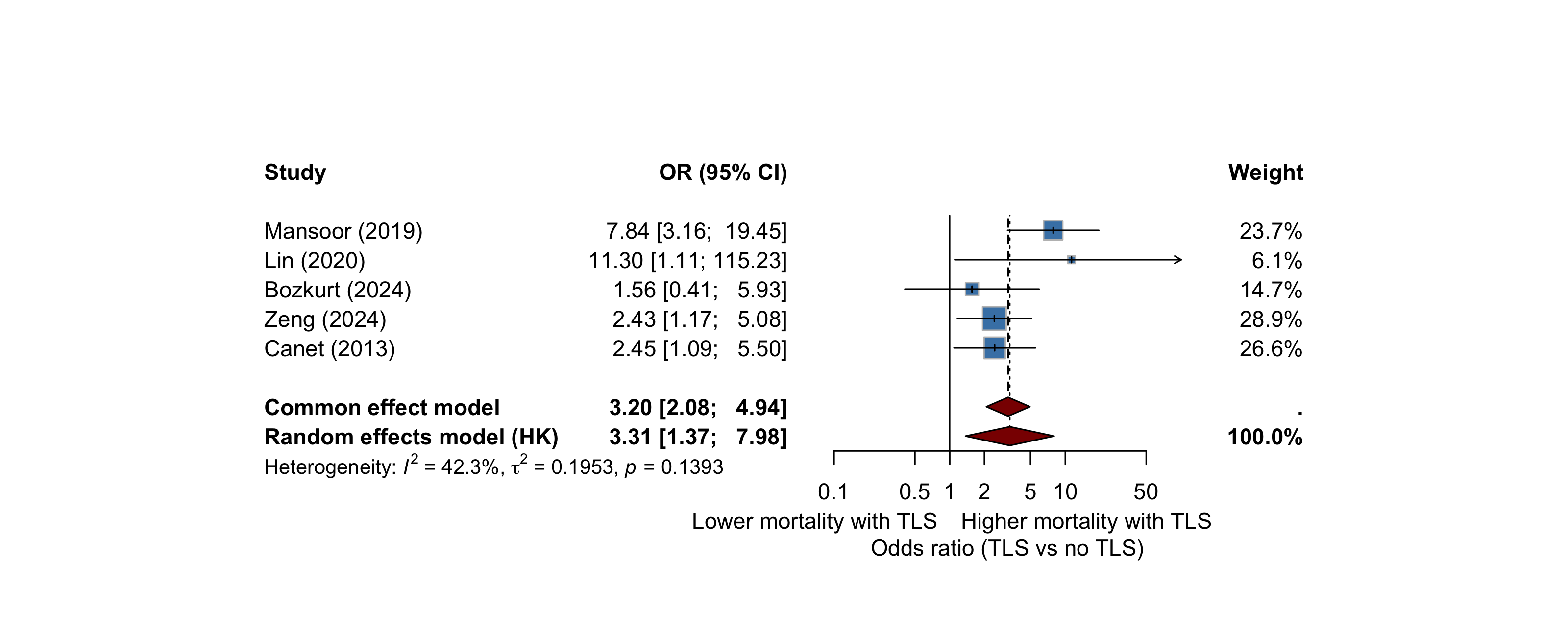
OR 3.31 (95 % CI 1.37 – 7.98), p = 0.020, I² = 42 %

Across the five studies we are willing to defend on their own merits, TLS at presentation triples the odds of mortality in lymphoma patients.

Why one number isn’t enough

Stratify by adjustment × time window

Every leaf is k ≤ 2.

The OR 3.3 only exists when we average methodologically heterogeneous studies together.

→ no sub-pool is statistically robust on its own

The catch: this number is fragile

  • Stratify the 6 studies by adjustment status × mortality time window
    • No sub-pool contains more than 2 studies
    • The “intended” primary pool (crude × early mortality) = k = 1 (Lin 2020 only)
  • The pooled OR ~3 emerges only by averaging studies with different definitions

Warning

GRADE-prognostic certainty: VERY LOW

  • Downgraded for inconsistency (I² 42 %, magnitude varies 1.6–7.8)
  • Downgraded for indirectness (mixed time windows, mixed adjustment)
  • Downgraded for imprecision (k = 5, wide CI)
  • No “+1 large effect” upgrade — confounding cannot be excluded

Spontaneous vs treatment-induced — different diseases

🚨 Spontaneous TLS

At admission, before any chemotherapy

  • Marker of overwhelming tumor burden; body failing before treatment begins
  • Listed as a specific risk factor in NCCN B-cell & T-cell Lymphoma guidelines

Effect estimates:

  • Pediatric LMIC Burkitt — aOR 7.8
  • HIV-NHL — OR 11.3
  • Abdel-Nabey 2022 (ICU cohort n = 153): spontaneous TLS independently predicts 1-year mortality, adjusted HR 1.65 (1.01–2.69)¹

High-mortality cohort

💊 Treatment-induced TLS

Days 1–7 of induction chemotherapy

  • Hypothesis: marker of chemosensitivity — tumor is responding violently
  • Indirect support: rasburicase use (proxy for severe lysis) improved 1-year remission HR 2.45 (1.17–5.15)¹

Effect estimates:

  • Bozkurt 2024 — OR 1.6 (NS)
  • Sall 2026 — log-rank p = 0.7 (null)
  • Zeng 2024 — higher uric acid at TLS onset → better survival

Often a transient bump

¹ Abdel-Nabey et al., Ann Intensive Care 2022 — n=153 critically-ill TLS patients, multivariable Cox

Bedside decision pathway

Two questions decide everything

  1. When did TLS appear?
  2. Is there organ dysfunction?

Everything downstream — ward vs ICU, timing of rasburicase, chemotherapy delay — follows from these two answers.

Bedside summary 📸

Clinical scenario Action Evidence
Adult DLBCL + lab TLS (no organ dysfunction) on R-CHOP days 1–3 Continue treatment, hydrate 1–3 L/m²/day (UOP ≥ 2 mL/kg/hr), allopurinol ± rasburicase, q 6 h labs + telemetry. No automatic ICU. Coiffier/Cairo JCO 2008; NCCN B-cell; NEJM 2025 ¹. Montesinos AML n=614: LTLS mortality 21 % vs 24 % without TLS (NS); CTLS mortality 83 % ²
Adult lymphoma + clinical TLS (Cr ≥ 1.5× ULN, arrhythmia, seizure) Rapid nephrology, low ICU threshold, rasburicase, early RRT Coiffier JCO 2008; NEJM 2025; 83 % CTLS mortality signal ²
Spontaneous TLS at presentation (Burkitt / HIV-NHL / bulky DLBCL with renal involvement) High-mortality cohort. Consider ICU during cytoreductive prephase regardless of TLS grade Abdel-Nabey 2022: spontaneous TLS HR 1.65 (1.01–2.69) ³; NCCN lists as specific risk factor
Pediatric Burkitt, any setting High TLS risk; rasburicase prophylaxis; aggressive supportive care Mansoor 2019 aOR 7.8; Cairo 2010; NCCN pediatric

¹ Bociek & Lunning, NEJM 2025 · ² Montesinos et al., cited in Coiffier JCO 2008 · ³ Abdel-Nabey et al., Ann Intensive Care 2022

Clinical-judgment statements grounded in very-low-certainty pooled evidence + guideline support. Local protocols and individual patient factors should override.

What this synthesis does not cover

Warning

This pool excludes — for newer-therapy TLS, see Bociek & Lunning, NEJM 2025;393(11):1104–16:

  • Immune checkpoint inhibitor TLS (rare but distinct mechanism)
  • CAR-T cell therapy TLS (CRS overlap)
  • BCL-2 inhibitor / venetoclax TLS (ramp-up dosing strategies)
  • Bispecific T-cell engager TLS (emerging signal)

Plus the deferred remediation queue:

  • Embase + Cochrane CENTRAL searches
  • Dual-reviewer screening on the full 669-record corpus
  • Citation chasing of all included studies
  • Wössmann 2003 NHL-BFM, MD Anderson rasburicase series, Howard 2011 panel cohorts

Take-home

  1. TLS at presentation probably triples mortality odds in lymphoma — pooled OR 3.31 (1.37–7.98), but the magnitude is uncertain
  2. The clinically important split is spontaneous vs treatment-induced — same label, different diseases
  3. GRADE certainty is VERY LOW — motivates research, doesn’t direct practice
  4. Risk-stratified management beats categorical recommendations

📂 github.com/htlin222/lymphoma-TLS-outcome

Manuscript · R code · screening decisions · two rounds of peer review · all artifacts

Acknowledgements & disclosures

  • AI-assisted meta-analysis pipeline — see project repository for full audit trail
  • Two rounds of peer review (6 simulated reviewers, statistical / clinical / SR-methodology / editorial / clinician end-user)
  • All extracted data, R analysis scripts, and reviewer reports are publicly available

Disclosures: No funding. No conflicts of interest. This is a rapid evidence synthesis and should not be cited as a systematic review.

Live slides: htlin222.github.io/lymphoma-TLS-outcome